Li Hui Cham / notes
Sep 20, 2026
Treat your work like craft
It all started with this calendar invite.
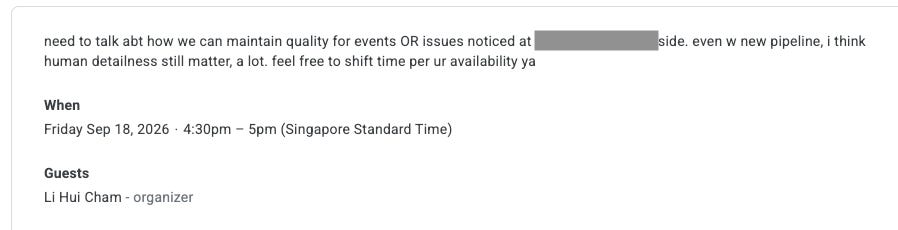
I was angry.
AI has sped up our workflows and multiplied our output, but it didn’t really make me any more satisfied at work. If anything, it went the other way.
It is extremely frustrating to see how much care you put into your work, vs how little of a shit some people give about theirs.
Workslops
Almost every day I see AI workslops1 presented in meetings and thrown around in Slack channels. Slide decks are the most obvious ones.
We are no longer guessing which lever works. Harvest validated the pattern....The canonical rebuild is the remaining lever.
Wtf is this. It’s a real extract, on a slide that was supposed to give insights and recommendations for our product launch. It was presented at an executive sync.
Instead of the sender (creator) doing the cognitive filtering and the thinking, all of it gets offloaded to the receiver. I love this excerpt from a HBR article
“It created a situation where I had to decide whether I would rewrite it myself, make him rewrite it, or just call it good enough.”
Workslop has always been there. AI simply accelerates the mediocrity.
Some common behaviours :
Business users query their own data with AI now, which is genuinely a good thing, except a lot of them don’t sanity check their numbers2. These days, Claude is pretty convincing. Only when you push back does it admits that it “overestimated” or “made an incorrect assumption”. Duh.
Some believe they can cram any information into a SKILL.md or KNOWLEDGE.md file and everything downstream will sort itself out. No, it won’t. If the underlying data model is a mess or the foundation work was done poorly, AI just surface the mess earlier.
All of it simply makes you look less trustworthy and less competent. That toxicity compounds within a team and hurts relationships between coworkers.
Why treating your work like craft matters
Take learning music as an example. A hobbyist’s goal is to produce a sound that is melodious. A musician spends time understanding the layers underneath (harmony, rhythm, melody).
A long time ago, I stopped treating work as a checkbox on a to-do list or a deadline to meet. I care about every aspect of it.
I ask important questions, which I aim to answer them along the way :
What details do I need to check before this code goes to production or the deck gets sent out
What skill can I strengthen here, or what gap can I close ?
How does this project contribute to the team or company goals ?
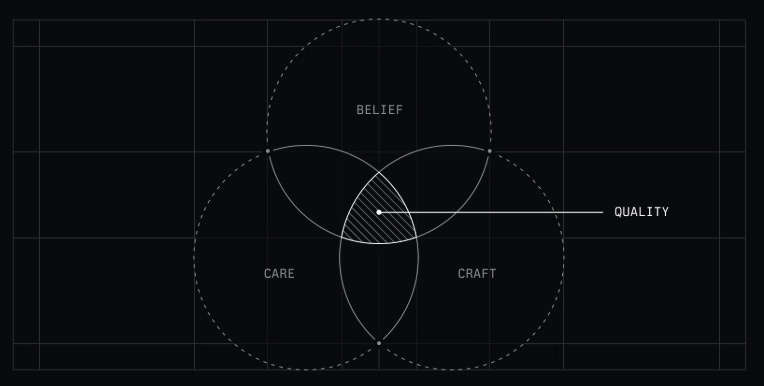
The craftsman mindset raised the quality of my output and my skill level. It also came with a benefit I didn’t expect : it helped me set boundaries. Being intentional about each step makes it easy to prioritise the work that matters and say no to distractions.
As you continue to deliver your work with care, you build a reputation with the people around you - your boss, your peer, heck even your intern. They may not have the words to describe what makes your work different, but they can certainly feel it.
How I treat my work like craft
In my day-to-day work, there are five main pillars : code, documentation, architecture, instructions, troubleshooting.
Code
Nobody writes code from scratch anymore and I’m fine with that. However, there’s a growing concern that AI is writing sloppy code faster than junior engineers can develop the judgement to catch it. For this, I recommend pstack to help you ship quality code with agent skills.
Documentation
Good documentation allows the reader to understand it in one pass. Visualisations, numbers and analogies help, but use them intentionally. Personally, I think Stripe and Vercel has pretty good technical documentation. To write better, read more. This skill applies to making slides too.
Architecture
With AI, everyone’s a manager now, and the AI is your intern. Interns need explicit instructions. So before I work on a problem, I design the architecture first : the business problem, the expected impact, the industry benchmarks, the technical best practices. Plan mode in any agentic coding tool helps a lot here. This applies just as much to regular business and operations work, where the architecture is workflows and SOPs.
Instructions
This covers what you hand to stakeholders, users and juniors. The more explicit you are, the less friction they face during onboarding, and the fewer times that come back to you with the same question.
Troubleshooting
Things break. What matter is how we recover. When applying a fix, I try to cover as many edge cases as I reasonably can and avoid relying on temporary patches. I try to be fast, because someone’s work is probably waiting on my resolution. And if no one is affected by the failure, that’s a signal for me to deprecate the thing and save myself the hassle next time.
Quality matters. Craft matters.
We make a choice to care about our work.
Maybe we are the only ones doing it in our team.
I still think it’s the right thing to do.
It starts with one person, and gradually we influence the people around us.

This HBR podcast describes how AI workslop destroys productivity in a workplace, and why people create it. I’d add that leadership direction matters too. A leadership that yells “AI, AI, AI !!! Use AI or else get fired” without investing in training its employees is one of the key drivers of this mess. Workslop also gets created when employees are burnt out or overloaded : “I’ve given you a Claude 5x Max subscription and therefore you should be able to produce more work.”
Good business leaders are sensitive to numbers. They’re data-trained, and they can spot bullshit at a glance. Two months after I joined Pluang as a fresh graduate, I showed a distribution of percentages that should have summed to 100% and didn’t. I had calculated them by hand, and I was careless. A C-level called it out in a Slack message. I learnt my lesson.