Li Hui Cham / notes
Sep 27, 2025
The Max You Can Get Might Be What You Already Have
"Sometimes the max you can get out of something is what you've already gotten, and that's fine." - a product leader. It was brutal, but real, and it bugged me for days.
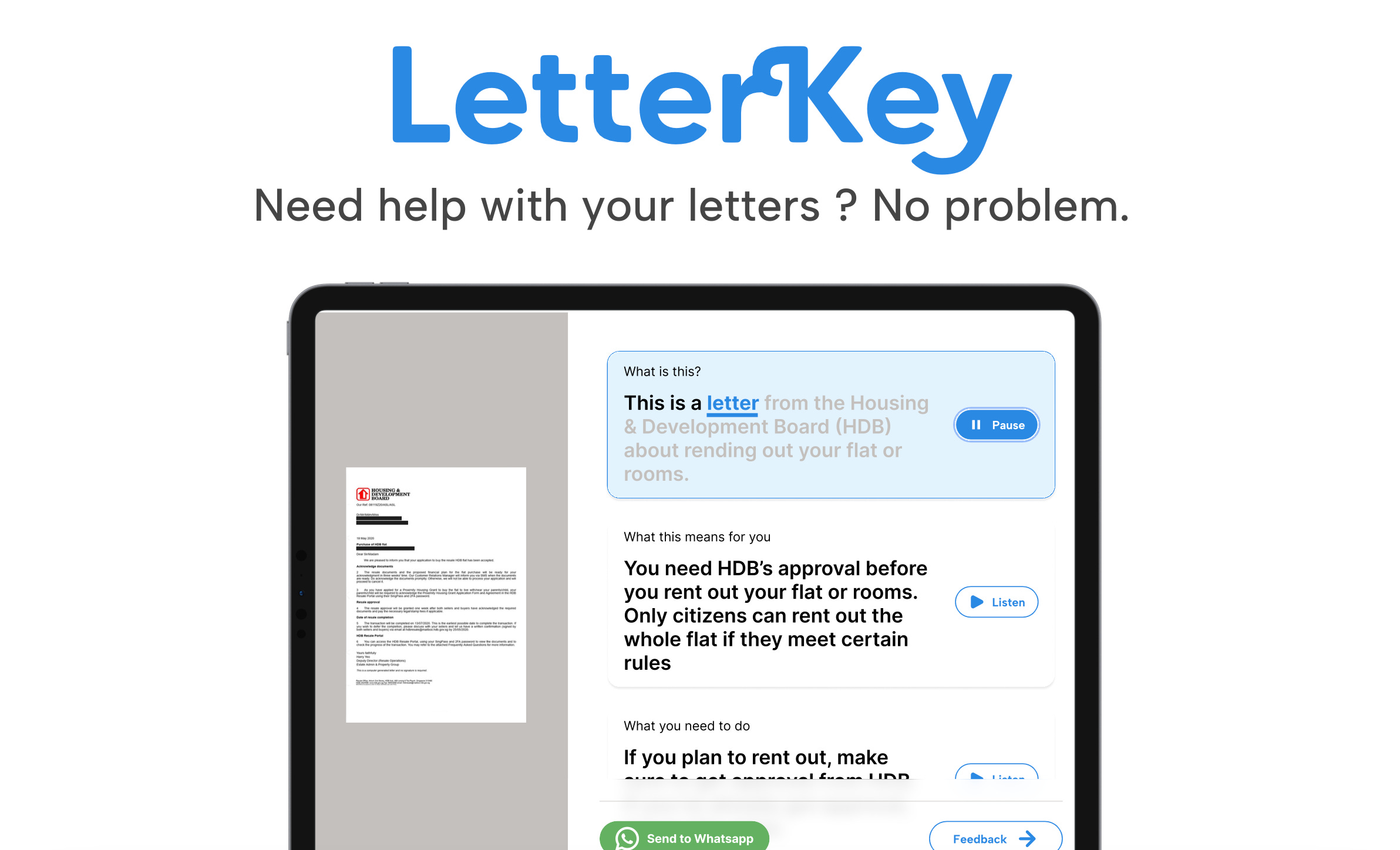
Quick context :
June 2025 : I joined Open Government Product’s yearly Community Hackathon and started building a product for public good, focused on seniors in Singapore.
July 2025 : We won the hackathon and SGD 20,000 to fund the product, LetterKey. For the first time in my life, I appeared on national TV news, a ~15-second interview.
Aug 2025 : Now part of the Build for Good 2025 Accelerator now. We piloted the idea at Bukit Panjang CC every Sunday in August. We printed brochures and name cards for the team, and got 150 seniors to try the product.
Sep 2025 : To date, 1,100 letters processed, 23% of them in dialects. We did so well at the finale that we were featured in The Straits Times newspaper (Sep 7). Everyone wanted to partner with us - People's Association, the Agency for Integrated Care, SG Enable, and more.
Oct 2025 : What’s next ?
Yes, what's next ? The real questions:
The business model. Startup/ground up/non-profit
The end game. Exit for money, hand over to other volunteers, or open-source it ?
As team lead, I couldn’t answer the two most important questions myself. Other teams praised our stats and our long list of interested government partners, but deep down I knew one thing for certain - if we couldn’t answer those questions with total clarity and honesty, we couldn’t move forward as a united team with a shared goal.
What’s faster than researching entrepreneurship? Picking the brains of actual entrepreneurs. So I reached out to a founder and a product leader for real advice and brutal feedback. Here’s what I got.
Do you believe in the product itself ?
As in, would you pay for it, or quit your job to work on it?
Quitting is the extreme end, sure. But paying for it, even a one-time, low-fee payment? My honest answer is no.
Before I get into why I don't believe in my own product, let me walk through how LetterKey was built.
OGP’s Community Hackathon wasn’t a normal hackathon, where you code for 24 hours, demo your app to a panel, and they pick a winner. Instead, they gave us access to community builders and social workers on the ground to identify the problem before building anything. It was problem-focused, not solution-driven. Then we spent about three months on everything from user research to piloting.
We all came from a student background, including me (I had just graduated in June 2025), which means our experience was mostly internships, where you rarely get a seat at the adult table to make real decisions. We had close to zero experience building a product or making business calls.
The current version of LetterKey is a feature disguised as an app.
And here’s the scarier part. Yes, Singapore is an ageing society, but it’s also a highly educated one, and the next batch of seniors, aged 55 and up, are literate in English and comfortable with technology. Even during our pilots, plenty of seniors already knew how to use Google Translate, web search, even ChatGPT. Once the Pioneer and Merdeka generations pass on, LetterKey won’t have much runway left. No government agency, and certainly no VC, invests in a product with a shrinking market.
Anyone can build the same thing with an LLM, and our only claimed edge is a senior-friendly UI. That single fact is enough to make me stop believing in it. And I can't sell what I don't believe in.
To fix this, and to justify continuing, we'd have to go back to ground zero: problem discovery. This time the goal is to find the most painful problem that seniors, agency staff, social workers, and caregivers face. Something that makes them say : "This is such a pain, I can't believe I deal with it every day. I wish an app could help."
The problem we're solving now is "cheap." Not unimportant, but not expensive enough for me to put a price tag on it and charge a consumer or an agency. We need to find that pain-in-the-ass problem.
Will you spend 4 hours a day on this? On top of your full-time job?
My mentor, the founder of a tech company, told me he spent four hours every night, 8pm to midnight, for eight months on his idea before quitting to go full-time.
That means going back to where we were three months ago: one senior, one staffer, one caregiver at a time, listening and talking. We have more partner resources now and can be more targeted about who we speak to, but it doesn’t change the reality:
We need to examine every problem the user faces and become the painkiller, the only one in Singapore, for it. People pay desperately for painkillers, not vitamins.
We solve them one at a time and test feasibility. Demo, test, fail. Demo, test, fail. Again and again, until we find a niche edge to build on.
Counting weekday and weekend hours, that’s a minimum of 10 hours a week, and 16+ at peak. Everyone on the team has to agree to it.
LetterKey is a side-quest for us now, with no shared payoff binding the team together. Given that, and given each of our own life and career priorities, are we still willing to make it a high-effort side-quest and see it through without giving up ?
Only after we answer these three questions, with total clarity and honesty, can we start thinking about :
The 2026 goalpost. Then work backwards to set LetterKey’s mission, milestones, and metrics.
Staying focused. Getting procured by a government agency takes years. Money can’t be the end game, but we still need an achievable target to aim at.
The product. Our partners were clear: if they can find something better, cheaper, or more credible on the market, we won’t make the cut.
Have I reached my maximum?
I’m still sitting with this one. I’m voting between:
(A) Call it off now.
(B) Continue with all my blood, sweat, and tears.
Update : Two months later, I had my answer.